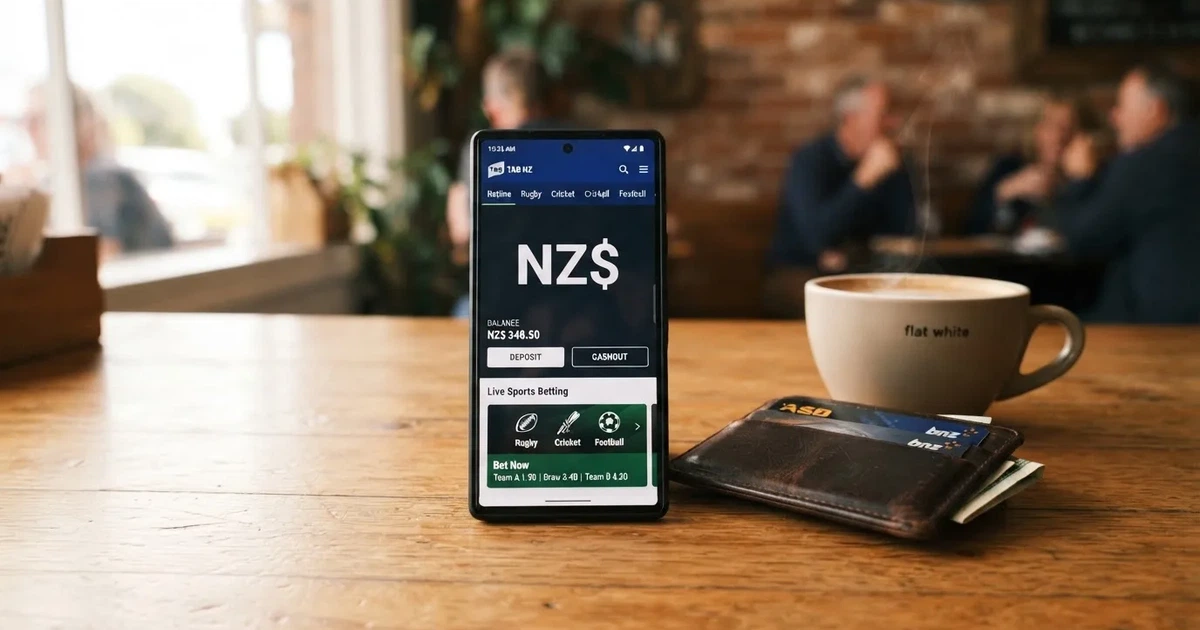


Bank transfer sports betting in New Zealand in 2026: which routes a punter actually has
 Available in US
Bank transfers land at the cashier, settle from one account to another, and on a New Zealand bet slip they look like the dullest part of the page. The interesting bit is everything wrapped around them: who will take a Kiwi punter’s deposit, what the bank will and will not block, how quickly a winning same-game multi comes back, and what a bettor loses when the operator behind the transfer has no licence at home. That is what this page is about. The angle is choice — which payment paths exist, who each one suits, and what each one costs.

26 October 2026 — checked against TAB NZ’s published terms and the Department of Internal Affairs register.
Table of Contents
- How bank transfers work at New Zealand betting sites
- TAB and Betcha: the only New Zealand-licensed routes
- Cashier mechanics: deposit, wager, withdraw
- What the bank transfer actually costs
- The wider landscape: choices a Kiwi punter actually has
- Responsible gambling: the safety net a New Zealand punter actually has
- A comparative look at the routes
- Operator reviews
- The other brands a Kiwi punter meets
- Choosing a route: who each one suits
- A note on what the page does not do
- Frequently asked questions
How bank transfers work at New Zealand betting sites
The rail that carries the money
A bank transfer between two New Zealand accounts does not pick its own path. Most of the time it rides the Faster Payments Service, launched in 2008 and operated by Pay.UK for British banks and broadly mirrored in the domestic clearing systems that New Zealand banks use. The rail runs 24 hours a day, seven days a week, and most payments arrive instantly or within a couple of minutes. Occasionally a transfer can take up to two hours when the bank needs an extra check. From the punter’s seat this matters mostly at withdrawal time: the deposit almost always clears before the bet is placed, but the payout waits on the same rail going home.

The mechanics behind that rail explain most of what a punter notices. A same-day transfer means the bookmaker’s payment team did not hold the funds; a one-day withdrawal means somebody on the operator’s side clicked a queue. The Faster Payments limit per transaction sits well above any reasonable stake, so a cap on deposit size is almost always an operator term, not a rail term. New Zealand banks operate within equivalent real-time frameworks, and the same general pattern holds: the bottleneck is the operator’s release, not the bank’s.
What a bank might quietly refuse to send
A New Zealand customer can find that a perfectly legal transfer has been refused at the source. The major retail banks have spent the last several years rolling out gambling transaction blocks on debit cards and, in some cases, on direct debits. The pattern started in the United Kingdom in 2018, when Monzo introduced a gambling transaction block that customers switch on instantly with a 48-hour cooling-off period before it can be turned off. Barclays followed at the end of that same year with an equivalent toggle inside its banking app. Starling Bank took the same approach: the block takes effect the moment it is switched on, and a 48-hour cooling-off period has to run before gambling transactions become possible again. NatWest took a narrower route, offering a gambling transaction block on its credit cards but not on its debit cards. The intent is consumer protection. The effect for the bettor is that a deposit can fail for reasons the bookmaker never sees.

The New Zealand banks have moved more cautiously than the British ones. There is no published order compelling any retail bank to refuse gambling payments, and the major New Zealand banks do not advertise a single switch-style gambling block of the Monzo kind. What does happen is the long-standing right of a bank to decline a transaction it considers inconsistent with its terms, and the merchant-code filtering many banks now apply. If a New Zealand punter sees a transfer fail at the source, the failure almost always traces to one of three places: the bank’s own merchant-code rules, the bank’s discretionary decline, or the operator’s deposit limit having been reached.
Bristol University research looked at what happens after a customer actually turns a block on. Around half of those customers had spent less or no money on gambling after switching the block in. That is a striking number from a research project that did not require anybody to give up betting entirely; a toggle that cuts spending in half is doing something real to the way people spend. For the punter, the lesson is that the bank’s behaviour matters as much as the bookmaker’s when a deposit goes through.
TAB and Betcha: the only New Zealand-licensed routes
One operator, two brands
New Zealand does not run a multi-licence betting market. Since an amendment to the Racing Industry Act 2020 took effect on 28 June 2025, TAB NZ and its online sister brand Betcha are the only operators allowed to take online sports and racing bets from people in New Zealand. The Department of Internal Affairs told providers serving New Zealand to withdraw with immediate effect. There is no licence to apply for and no licence register for bookmakers, because there is only this one lawful provider. Anything else presented as “licensed in New Zealand” for sports or racing betting is not.
The mechanics behind that monopoly are worth one paragraph. TAB NZ’s partner Entain runs the TAB business under a 25-year agreement signed in 2023 that gives Entain a 50/50 share of gross profits, with at least NZ$150 million a year going to TAB NZ for the first five years, and Entain pledged a one-off NZ$100 million payment to the racing sector. So when a punter bets on TAB or Betcha, the betting profit is split fifty-fifty with Entain, and TAB NZ itself is funded to channel money back into New Zealand racing. That is the structural reason there is no other licensed competitor — the arrangement was built as a partnership, not as an open market.
Betcha sits alongside TAB as the second brand under the same TAB NZ umbrella. They are one operator group, never rivals; the second brand exists to reach online customers who might not walk into a retail TAB. Anybody who reads TAB and Betcha as competing bookmakers has misread the page.
What TAB NZ publishes on deposits and withdrawals
TAB NZ does not publish a fixed public list of deposit methods the way an offshore sportsbook does. The published betting rules are silent on minimum deposits, the cashier’s supported rails and the exact processing window for withdrawals. What the operator does publish — through its app and its help pages — is a simplified wallet for deposits and withdrawals, deposit limits that a customer can set inside the app, time-outs, and self-exclusion. Anyone betting with TAB NZ needs to set those limits before chasing a withdrawal.
What that means in practice is that the punter, not the operator’s published rules, is the one who sees the deposit menu. TAB NZ’s deposit methods come only from its own terms, and the limits on each method are operator-level. There is no statutory payment rule in New Zealand for betting accounts, so the only source of truth for which card brand, which direct-debit rail or which bank transfer is accepted is TAB NZ’s own cashier at the moment of deposit. A reader who wants to confirm the rail before opening an account has to check TAB NZ’s own page on the day they bet.
What the New Zealand framework actually says
The Department of Internal Affairs is the gambling regulator under the Gambling Act 2003 and monitors compliance with the betting prohibition written into section 92A of the Racing Industry Act 2020. The Racing Industry Amendment Act 2025 inserted section 74AAA, which closes the field to anybody other than TAB NZ. The change took effect on 28 June 2025. DIA told providers serving New Zealand to withdraw with immediate effect, and a person or company taking a bet from a Kiwi punter in breach of that section is breaking New Zealand law.
The law does not geo-block offshore websites. It puts the liability on the offshore operator, not on the player. Section 19(4) of the Gambling Act 2003, inserted in 2025, says an individual may not be convicted for placing a bet with an offshore betting operator in breach of section 74AAA. No source states a published penalty for a player, and DIA’s own messaging focuses on operator risk: the Department warns that overseas operators may be in jurisdictions with minimal consumer safeguards, may not return unspent credits and may not pay out large wins. That warning is the regulator telling Kiwi punters what they are giving up by betting outside TAB NZ — not the regulator telling them they will be prosecuted.
The greyhound picture is narrower. Greyhound racing is closing in stages from 1 August 2026, and from that date offshore operators may not take bets on greyhound races either. So even before that date, greyhound betting through offshore sites carried an extra layer of regulatory risk; from 1 August 2026 the only legal route closes entirely.
Tax and the boring side of a payout
The Inland Revenue position on recreational gambling winnings is that they are generally not taxable. Prize money from TAB horse, dog and trotting races is not taxable. A person who bets as a business sits in a different case and is advised to talk to Inland Revenue or an accountant rather than depend on this paragraph. On the operator side, TAB NZ pays the Problem Gambling Levy at 0.74%, in force from 1 July 2025 to 30 June 2028; overseas operators supplying New Zealand residents pay online gambling duty at 12% of profits since 1 July 2024, rising to 16% from 1 January 2027. The duty is not a legality stamp — a bookmaker paying tax on its profits does not make taking a bet from a Kiwi punter lawful, and the page never reads it that way. The point-of-consumption charge on offshore racing and sports bets ceased on 30 June 2026, which removes one accounting line from the offshore side but does nothing for the breach of section 74AAA itself.
Cashier mechanics: deposit, wager, withdraw
Deposits, end to end
A deposit at a New Zealand-licensed sportsbook starts at the wallet inside the TAB NZ or Betcha app. The punter picks a method, enters an amount, confirms. From there, three things happen in parallel: the operator’s cashier authorises the amount, the rail carries it, and the customer’s bank debit posts. At the rail layer the deposit is essentially instant on Faster Payments-style systems, with a tail of up to two hours on the rare transfer that needs an extra check. From the punter’s perspective the deposit looks instant except when the operator sets a higher minimum or when the bank’s own merchant-code filtering refuses the transaction.
The minimum deposit is a TAB NZ term, not a rail term. The published New Zealand betting rules do not state a public minimum, and the cashier tells the customer the floor at the moment of deposit. For punters who want a defined number to budget against, that means checking the cashier before opening the account — not relying on a comparison page to set the budget.
For an offshore bookmaker that a Kiwi punter reaches despite the section 74AAA prohibition, the cashier mechanics look different. Sportaza’s terms, for instance, do not list New Zealand among the excluded jurisdictions, and the NZD appears in the withdrawal limits table. RTbet follows the same pattern: New Zealand is not in the excluded list, and NZD limits run from NZ$1,000 per day and NZ$13,000 per month at the Bronze level up to NZ$3,000 per day and NZ$35,000 per month at Elite. FunBet publishes the same shape: New Zealand absent from the exclusions and NZD in the withdrawal table. None of that makes those operators lawful in New Zealand — section 74AAA still applies — but it does explain why the cashier appears to accept a New Zealand customer.
Withdrawals, and why speed varies
The withdrawal leg is the one punter-side complaint that ages badly. A TAB NZ or Betcha withdrawal goes back through the wallet the punter used to deposit, and the published processing window is set by the operator’s own release. The bank rail then carries the funds home. The deposit, then, of the rail is fast; the bottleneck is the operator’s payment team authorising the release. A punter who has set a deposit limit but has not asked for a withdrawal before can find a withdrawal sitting in a queue for one or two business days while the operator checks identity documents and reconciles the wallet.
For a punt using bank transfer as the withdrawal rail, the typical pattern is: operator release first, rail arrival second. The total time is operator release plus the rail’s own window, which is normally minutes once the operator clicks. The punter’s worst case is the operator holding the funds pending a source-of-funds check, which can happen at any size. New Zealand does not publish a statutory maximum on operator release; the only published floor on payout speed is what TAB NZ states in its own terms at the moment of withdrawal.
Where a multi bet fits in
The TAB NZ app supports Multis and Same Game Multis — multi bets whose legs come from one event. A same-game multi on Super Rugby Pacific leg combines one leg from each of several markets on a single match: first try-scorer, total points, head-to-head. A punter who has bet on several legs at decimal odds of, say, 1.50, 2.00 and 3.00 receives a combined price of 1.50 × 2.00 × 3.00 = 9.00. A $10 stake returns $90 if every leg wins, with $80 of that being net profit. The bookmaker’s margin sits inside each leg of that multi, and the longer the multi the more margin compounds. A two-leg multi carries the margin of two markets stacked; a five-leg multi carries five. Punters looking for the cheapest multi usually clear the by-product of the cheapest singles, and a section like the one further down this page on what the margin is for is the place to read that arithmetic.
What the bank transfer actually costs
Fees on the rail
Bank transfers within New Zealand’s domestic clearing systems generally carry no consumer fee for the sender or the receiver. The same holds for the Faster Payments Service in the United Kingdom, which is the rail most offshore books use when they pay British customers. The bookmaker’s bank may charge the operator a small fee per transfer, but that fee is on the operator’s side and does not appear on a punter’s statement. The rail itself is free to the customer.
Where the punter does see a cost is at the edges. Some New Zealand banks charge a small fee for overseas currency conversion, which bites when an offshore bookmaker pays out in EUR or USD rather than NZD. Some banks charge for transactions on accounts below a balance threshold. These costs are bank-side and vary by institution; the punter’s own bank’s fee schedule is the source of truth.
Currency conversion
For a New Zealand punter betting with TAB NZ or Betcha, the account is denominated in NZD throughout: deposit, stake, winnings. For a Kiwi punter who chooses to bet with an offshore bookmaker — accepting the section 74AAA risk — the deposit rail still arrives in NZD, but the operator’s internal wallet may convert the deposit into EUR or USD before crediting the betting balance, and the same conversion runs in reverse on a withdrawal. The conversion spread is the operator’s revenue on the FX leg. A typical offshore bookmaker charges between 1% and 3% of the converted amount as a spread, and that spread comes out of the punter’s withdrawal before the funds land in the New Zealand account.
A punter who wants to control the FX cost has three honest options: stick to TAB NZ or Betcha and stay in NZD throughout; pick an offshore bookmaker that holds NZD balances end to end (a few do); or accept that the FX spread is the price of betting offshore and budget for it. The first option carries no FX cost at all and is the one the regulator points to.
The “free” deposit that isn’t free
Most deposit methods on most sportsbooks carry no fee for the customer, and bank transfers are usually at the front of that pack. The punter’s hidden cost is not a per-transaction fee; it is the bookmaker’s margin inside the odds, plus any FX spread, plus any deposit-method surcharge some operators apply to credit cards or specific prepaid rails. For a punt on a TAB NZ fixed-odds market at decimal odds of 2.00 on each side of a head-to-head, the punter’s expected loss on a $10 stake is roughly 5% of turnover — about 50 cents per $10 bet. The bank transfer does not change that. The rail is free; the bet is not.
The wider landscape: choices a Kiwi punter actually has
The TAB NZ / Betcha monopoly
The honest first choice is the only legal one. TAB and Betcha are the two lawful online brands of TAB NZ; they cover fixed-odds racing and sports, tote (pool) bets, racing form, Blackbook and Jockey Challenge tools, and Trackside live race streaming with in-app betting. The published betting rules list the bet types a punter will meet: Win, Place, Each Way, Quinella, Exacta, Trifecta, First Four, Double, Treble, Daily Double, Running Double, Quaddie and Big6, plus Multis and Same Game Multis. Live betting is listed in the TAB NZ apps, and there is no statutory restriction on in-play markets.
The customer protection piece is what makes TAB NZ a different offer. The TAB NZ app includes deposit limits, time-outs and self-exclusion tools a punter can switch on inside the app, and the exclusion applies across both brands. Help lines are listed inside the app: the free New Zealand Gambling Helpline at 0800 654 655 and the text line at 8006. Inland Revenue guidance treats recreational winnings as non-taxable. The Problem Gambling Levy that TAB NZ pays funds harm-minimisation programmes across the country.
A punter who only bets with TAB NZ gets the regulator’s oversight, the harm-minimisation framework and a complaints route that reaches a New Zealand body. That is a real package, and the only legitimate downside is the absence of competition. If the price the operator posts on the All Blacks to win the Rugby Championship looks long, the punter has no domestic rival to compare it against.
The offshore routes Kiwi punters actually meet
Six offshore brands sit on the typical Kiwi punter’s comparison page. The first is Winz.io, which lists itself as a crypto casino and sportsbook: it accepts BTC, ETH, LTC, BCH, DOGE, USDT, BNB, ADA, TRX, XRP and SOL, deposits are made by connecting a crypto wallet, and the site advertises no deposit limits and instant withdrawals. Bank transfer is not the rail here; the rail is a coin transfer on a blockchain, and the punter trades a bank transfer’s regulator visibility for a wallet’s anonymity.
The second is Sportaza, which publishes NZD withdrawal limits in its terms without listing New Zealand as an excluded jurisdiction. The third is RTbet, which does the same thing at a slightly different tier ladder. The fourth is Rooster.bet, which takes card deposits by Visa and Mastercard with a €20 minimum, instant processing and no fees, and pays card withdrawals back in one to three banking days. The fifth is FunBet, which again keeps New Zealand out of the exclusions and publishes NZD withdrawal limits. The sixth is a list of further brands — Boomerang Bet, Thunderpick, Megapari, BillyBets, Golden Panda, Rabona — each running its own sportsbook with its own bonus programme.
None of those brands is licensed in New Zealand. Section 74AAA puts each of them on the wrong side of the law by the act of accepting a Kiwi punter’s stake. The cashier mechanics will work, the bank transfer will arrive, the bet will settle — and if the operator decides not to pay a large win, the punter has no New Zealand complaints route. DIA has put that warning on the record explicitly.
Crypto, e-wallets and the bank transfer’s cousins
The bank transfer is one of three rails a Kiwi punter meets in practice. The second is the card rail — Visa and Mastercard — which is what most New Zealand customers default to and which carries the merchant-code risk described earlier. The third is the e-wallet rail — Skrill, Neteller, MuchBetter and the like — which sits between the punter’s bank and the bookmaker, and which most operators do not list as a withdrawal rail for New Zealand. Crypto is a fourth rail that exists alongside, not inside, the bank system: Winz.io and the brands that follow its model hold balances in coins, settle bets in coins and pay out in coins.
For punters who want the bank transfer specifically, the rails split into two cases. A deposit to TAB NZ or Betcha is a domestic bank transfer that settles through the New Zealand clearing system. A deposit to an offshore bookmaker is a cross-border transfer that the operator’s bank receives in EUR or USD and converts to NZD before crediting the wallet — or accepts in EUR/USD and lets the wallet hold a foreign-currency balance. The first case is the clean one for a Kiwi punter; the second carries the FX spread described earlier.
Responsible gambling: the safety net a New Zealand punter actually has
Tools inside TAB NZ and Betcha
The TAB NZ app carries three tools a punter can switch on inside the app: deposit limits, time-outs and self-exclusion. The same tools apply across both brands because both brands sit under TAB NZ. A self-exclusion is the heaviest of the three and stops the account from accepting deposits and bets for the chosen window; a time-out is the medium-weight version with the same mechanics for a shorter period; a deposit limit caps how much the wallet accepts in a chosen interval. The punter can change each of these at any time from inside the app, and the operator publishes the help-line numbers alongside: 0800 654 655 for the free New Zealand Gambling Helpline and 8006 for the text line.
There is no single national online-betting exclusion register for sports and racing betting in New Zealand. The national register that the 2026 online casino law will introduce applies to online casinos only, not to TAB NZ or Betcha. That is a structural limit on what a New Zealand punter can ask of the regulator: the casino exclusion register is a different system.
What an offshore bookmaker’s safety net looks like
An offshore bookmaker’s responsible-gambling tools are its own. They typically include deposit limits, time-outs and self-exclusion at the account level, and a self-exclusion request is the operator’s decision to grant. The catch is exactly the catch described above: there is no New Zealand complaints route to an offshore operator, no New Zealand body that can compel a payout, and no New Zealand framework that compels the operator to honour its own harm-minimisation commitments. An offshore operator that ignores its own self-exclusion commitment has nothing behind it except its own terms. For a Kiwi punter that is the structural reason the offshore routes cost what they cost.
When the bank is the safety net
A New Zealand bank that blocks gambling transactions at the merchant-code layer is acting on the same impulse the Bristol research evaluated: customers who opted into a gambling block spent less or no money on gambling afterwards. The bank’s role is its own form of harm minimisation. It is not a substitute for the operator’s own tools, but for punters who have set a TAB NZ deposit limit and still want a backstop, the bank’s merchant-code filter is the second layer that runs beneath the operator’s. The two layers stack: the operator caps what reaches the wallet, the bank caps what reaches the operator. Punters who want both layers on have to set them both, and the bank’s is the one the punter does not have to negotiate with the operator about.
A comparative look at the routes
| Brand | New Zealand status | Bank transfer and key terms |
|---|---|---|
| TAB | TAB NZ brand — only lawful online sports and racing operator for people in New Zealand since 28 June 2025 | Domestic bank transfer through TAB NZ wallet; no published public minimum deposit; deposit limits, time-outs and self-exclusion in app; withdrawal rail is the wallet plus the bank rail back to the account |
| Betcha | TAB NZ brand — second online brand of TAB NZ, never a rival | Same TAB NZ wallet as TAB; deposit limits, time-outs and self-exclusion apply across both brands; bank transfer settles through the same domestic clearing system |
| Winz.io | Not licensed in New Zealand | No bank transfer rail; crypto-only deposits via connected wallet (BTC, ETH, LTC, BCH, DOGE, USDT, BNB, ADA, TRX, XRP, SOL); advertises no deposit limits and instant withdrawals |
| Sportaza | Not licensed in New Zealand | Bank transfer and card rails offered; NZD appears in withdrawal limits table from NZ$1,000 per day and NZ$13,000 per month at level 1 to NZ$3,000 per day and NZ$35,000 per month at level 5; New Zealand not in section 2.3 exclusions |
| RTbet | Not licensed in New Zealand | Bank transfer and card rails offered; NZD withdrawal limits from NZ$1,000 per day and NZ$13,000 per month at Bronze to NZ$3,000 per day and NZ$35,000 per month at Elite; New Zealand not in section 2.3 exclusions |
| Rooster.bet | Not licensed in New Zealand | Card deposits by Visa and Mastercard with a €20 minimum and instant processing; card withdrawals take 1-3 banking days; bank transfer availability not stated on the consulted page |
| FunBet | Not licensed in New Zealand | Bank transfer and card rails offered; NZD in withdrawal limits table up to NZ$3,000 per day and NZ$35,000 per month at level 5; New Zealand not in section 2.3 exclusions |
TAB and Betcha sit at the top of the table because they are the only lawful routes; the others sit below because they are not licensed in New Zealand and a Kiwi punter using them has no New Zealand complaints route. The reader who only needs the rail itself is best served by TAB NZ’s domestic bank transfer; the reader who needs a specific bonus or a market TAB does not carry is on a route that breaks New Zealand law at the operator’s end.
Operator reviews
TAB
TAB is one of two online brands of TAB NZ, the only provider lawfully offering racing and sports betting to people in New Zealand since the Racing Industry Amendment Act 2025 inserted section 74AAA. The brand carries fixed-odds racing and sports, tote (pool) bets, racing form, Blackbook and Jockey Challenge tools, Trackside live race streaming with in-app betting, and Multis and Same Game Multis. The wallet inside the app supports deposit limits, time-outs and self-exclusion, and the exclusion applies across both brands. Help lines — the free 0800 654 655 line and the 8006 text line — are listed in the app. The 25-year partnership with Entain is what funds the operation, with at least NZ$150 million a year going to TAB NZ for the first five years.
What a punt costs a Kiwi bettor at TAB is the settlement of the rail: domestic bank transfer with no fee, NZD throughout, no FX spread, no published minimum deposit the punter cannot see at the cashier. What the page cannot say is what each fixed-odds market is priced at, because those prices move with the form and the bookmaker’s own risk team. What the page can say is that every other brand on this list breaks New Zealand law by accepting a Kiwi punter’s stake. TAB is the brand a New Zealand bettor settles their outcome with, by structure.
The honest verdict on TAB is that it is the only legitimate sports and racing bookmaker in New Zealand, with full harm-minimisation tools and a regulator that can be approached. The price a punter pays is the absence of competitive pressure on the prices TAB posts. For a Kiwi bettor who values legality, harm minimisation and a complaints route that reaches a New Zealand body, TAB is the right answer; for a bettor who needs a price TAB does not carry, the alternatives sit outside New Zealand law.
Betcha
Betcha is the second online brand of TAB NZ, run on the same wallet and the same customer account structure as TAB. The brand exists to reach online customers who might not walk into a retail TAB outlet, and it carries the same fixed-odds racing and sports markets, the same tote bets, the same Multis and Same Game Multis, and the same Trackside live race streaming. The deposit methods, the deposit limits, the time-outs and the self-exclusion tool apply across both brands because both brands sit under TAB NZ. A punter who self-excludes on Betcha is self-excluded on TAB too.
The pricing structure is the same TAB carries on its main brand. There is no published minimum deposit the punter cannot see at the cashier, no published maximum the punter cannot see at the cashier, no FX spread because the balance is held in NZD end to end. The bank transfer arrives at the TAB NZ wallet through the New Zealand clearing system, settles quickly, and the rail is the rail every New Zealand punter uses for everything else.
The honest verdict on Betcha is that it is the same lawful product as TAB, with a younger customer base and a UI built for the punter who bets from a phone. The reason a punter might pick Betcha over TAB is the user experience; the reason to pick either is the section 74AAA monopoly, which makes any other sportsbook unlawful for a Kiwi bettor to use at the operator’s end. The same harm-minimisation tools, the same regulator and the same complaints route apply whichever brand a punter sits on.
Winz.io
Winz.io names itself a crypto casino and sportsbook. The cashier lists BTC, ETH, LTC, BCH, DOGE, USDT, BNB, ADA, TRX, XRP and SOL, deposits are made by connecting a crypto wallet, and the site advertises no deposit limits and instant withdrawals. There is no bank transfer rail on the consulted page — the rail is a coin transfer between wallets, and the punter who bets here trades a bank transfer’s regulator visibility for a crypto wallet’s pseudonymity.
Winz.io operates without a New Zealand licence and lacks authorisation to accept stakes from people in the country. The brand names Anjouan and Tobique licences (holder Novatrix SRL), and it does not provide a New Zealand complaints route or harm-minimisation framework. DIA warns that overseas operators may not return unspent credits and may not pay out large wins.
The honest verdict on Winz.io is that it is a crypto sportsbook that does not accept bank transfers. For a Kiwi punter looking specifically for a bank transfer rail, Winz.io is the wrong brand to read; for a Kiwi punter looking for any sportsbook at all, it sits on the wrong side of New Zealand law and offers no recourse rail against a segment of the regulator’s stated risks.
Sportaza
Sportaza runs a sportsbook and a casino on one wallet. The terms do not list New Zealand among the excluded jurisdictions, and the NZD appears in the withdrawal limits table — from NZ$1,000 per day and NZ$13,000 per month at level 1 to NZ$3,000 per day and NZ$35,000 per month at level 5. The cashier accepts bank transfer and cards, and the published terms do not state a fee on either rail. The level ladder is a tiered loyalty programme, and a punter at level 1 has a tighter daily and monthly ceiling than a punter at level 5.
Sportaza lacks a New Zealand licence and possesses no valid grounds to solicit bets from residents. Section 74AAA still applies, and the operator’s terms do not extend a New Zealand complaints route or a New Zealand harm-minimisation framework to the punter. The fact that New Zealand is not in the section 2.3 exclusions does not make the offer lawful; it makes the cashier willing to accept the deposit.
The honest verdict on Sportaza is that the brand accepts bank transfers and publishes NZD limits, and that none of that addresses the structural breach of section 74AAA. A Kiwi punter who bets here has the cashier’s mechanics on their side and the regulator’s framework against them, and the page is not in the business of telling them which way to bet. The trade-off is the NZD-denominated tier ladder against the absence of a New Zealand complaints route.
RTbet
RTbet runs a sportsbook and a casino on one wallet and offers the same tier ladder shape as Sportaza. The terms do not list New Zealand among the excluded jurisdictions, and the NZD appears in the withdrawal limits table from NZ$1,000 per day and NZ$13,000 per month at the Bronze level up to NZ$3,000 per day and NZ$35,000 per month at Elite. The cashier accepts bank transfer and cards, and the published terms do not state a fee on either rail.
RTbet is not licensed in New Zealand; it remains prohibited from accepting bets from New Zealand residents under section 74AAA. The operator’s terms do not extend a New Zealand complaints route or a New Zealand harm-minimisation framework to the punter.
The honest verdict on RTbet is the same shape as Sportaza’s: the brand accepts bank transfers and publishes NZD limits, and the structural breach of section 74AAA remains the relevant fact for a Kiwi punter. The differences between RTbet and Sportaza are at the bonus and tier edges, and those differences are the kind the punter checks in each operator’s own terms.
Rooster.bet
Rooster.bet takes card deposits by Visa and Mastercard with a €20 minimum, instant processing and no fees, and pays card withdrawals back in one to three banking days. The rail the punter meets first is the card rail; a bank transfer rail is not advertised on the consulted page. The cashier mechanics are simple and the limits are set by card type.
Rooster.bet is not licensed in New Zealand and does not offer its services to residents of the country.
The honest verdict on Rooster.bet is that the brand is a card-first sportsbook that does not advertise a bank transfer rail on the consulted page, and it sits on the wrong side of New Zealand law. A Kiwi punter who wants a bank transfer rail specifically reads Rooster.bet as a card option and the page does not recommend it on bank-transfer grounds. The €20 minimum is a clean number for budgeting, and the 1-3 banking-day card withdrawal is a published window a punter can plan around.
The other brands a Kiwi punter meets
Boomerang Bet, Thunderpick, Megapari, BillyBets, Golden Panda, Rabona
The page lists a handful of further brands because Kiwi punters meet them on comparison pages and on affiliate sites. Boomerang Bet runs a casino, live casino and sportsbook on one account and advertises a first deposit bonus of 100% up to €100 and a welcome bonus of 100% up to €500 plus 200 free spins on its English site. Thunderpick advertises a 100% deposit bonus up to €600 and recommends crypto for fast deposits, with other payment methods also available; its terms set the minimum withdrawal at €10 per transaction, and a €20 closing fee applies when an account is closed with a balance at or below €20. Megapari lists a free bet of 15% of the first deposit, a Free Bet Hour with 50% cashback on football losses returned as a free bet, and sports cashback; the Singapore version of the site shows in SGD and no New Zealand version of these terms was seen. BillyBets runs cashback and reload bonuses on sports, plus a coin shop where coins collected from depositing, betting, tournaments and challenges can be exchanged for free bets and free spins, and a five-level VIP programme. Golden Panda offers a sportsbook, esports and virtual sports, plus casino, live casino, crash games, rewards, cashback, a VIP Club, Golden Goals and Prediction Markets. Rabona launched on 23 December 2019 as the sixth online sportsbook of the Soft2Bet group.
None of those brands is licensed in New Zealand. Section 74AAA applies to each of them at the moment a Kiwi punter’s stake crosses the cashier. The brand-side descriptions are accurate as far as each operator’s own terms go, and the New Zealand reality is that none of those terms changes the section 74AAA picture. A Kiwi punter reading these brands is reading marketing pages of operators that are unlawful at this end of the rail.
Choosing a route: who each one suits
The punter who wants the regulator on their side
The punter who values the New Zealand regulator’s oversight, the harm-minimisation framework and a complaints route that reaches a New Zealand body has one honest answer: TAB NZ, accessed through TAB or Betcha. Both brands carry fixed-odds racing and sports, tote bets, Multis and Same Game Multis, live race streaming, deposit limits, time-outs and self-exclusion, and the help lines 0800 654 655 and 8006. The bank transfer settles through the New Zealand clearing system in NZD, with no FX spread and no per-transaction fee. The price a punter pays is the absence of competitive pressure on the prices TAB posts.
The punter who needs a market TAB does not carry
The punter who needs a market TAB does not carry — a niche esports market, an exotic line on a fight card, a high-roller sportsbook structure — meets the offshore brands on the second half of the table. Each of those brands is not licensed in New Zealand, and each of them carries the regulator’s explicit warning. The bank transfer rail on those brands is the rail they list at the cashier; the NZD withdrawal limits are set by the operator’s own tier ladder; the FX spread is the price of cross-border settlement. The trade-off a punter makes is the market they need against the absence of a New Zealand complaints route and the regulator’s stated risk that an overseas operator may not return unspent credits or pay out large wins.
The punter who wants the bank to backstop the operator
The punter who wants the bank’s merchant-code filter as a backstop beneath the operator’s deposit limit has one practical path: ask the bank to enable a gambling transaction block, set the TAB NZ deposit limit inside the app, and stack the two. The Bristol research found that around half of customers who opted into a gambling block spent less or no money on gambling afterwards. The two layers stack independently, and the punter’s worst case is the operator holding a withdrawal pending a source-of-funds check, which neither layer can prevent. What the two layers together do is reduce the volume of bets the punter places in a month, and the cost is the punter has to set both.
The punter who wants to bet in crypto
The punter who wants to bet in crypto sits on a different rail. Winz.io is a crypto-only sportsbook and does not accept bank transfers. The bank is not part of the deposit path; the wallet is. The trade-off a Kiwi punter makes is the bank transfer’s regulator visibility against the wallet’s pseudonymity, and the page does not recommend the trade. Section 74AAA applies at the operator’s end whether the rail is a bank transfer or a coin transfer, and the regulator’s explicit warnings about overseas operators apply whichever rail the bettor uses.
A note on what the page does not do
This page describes which operators accept bank transfers, what each one costs the punter, what the New Zealand law says, and what each route’s structural risks are. It does not invite the reader to sign up with any operator. It does not print a bonus code or a working link. It does not predict the outcome of any race, match or event. The terms that govern any punter’s actual bet live on the operator’s own page at the moment of deposit, and the punter’s own check of those terms is what binds the punter’s contract. The punter who sets a deposit limit and reads the cashier before opening the account has done the work the page cannot do for them.
Frequently asked questions
Can bank transfer be used on betting sites?
Yes, bank transfer works at TAB NZ and Betcha through the domestic New Zealand clearing system, and the rail typically settles the deposit within minutes. Most offshore sportsbooks also accept bank transfer for deposits and withdrawals, though the rail carries a currency-conversion spread if the operator holds the balance in EUR or USD. The rail itself is free to the customer on the New Zealand side.
Do any sports betting sites accept bank transfer?
TAB NZ and Betcha accept bank transfer as the deposit rail through their shared wallet, and offshore brands such as Sportaza, RTbet and FunBet also accept bank transfer at the cashier and publish NZD withdrawal limits in their terms. Rooster.bet’s cashier is card-first and a bank transfer rail is not advertised on the consulted page, while Winz.io is crypto-only and does not accept bank transfer. None of the offshore brands is licensed in New Zealand under section 74AAA of the Racing Industry Act 2020.
Which betting apps use bank transfer?
The TAB NZ app carries a bank transfer rail through its shared TAB NZ wallet, and the same rail applies on the Betcha app because both brands sit under TAB NZ. Offshore apps such as Sportaza, RTbet, FunBet and Rooster.bet each carry their own cashier; Winz.io’s app is crypto-only and does not carry a bank transfer rail. The bank transfer’s merchant-code filtering at the customer’s bank can affect whether a transfer reaches the operator even when the operator’s cashier accepts it.
Which payment methods does TAB NZ accept, and where are they listed?
TAB NZ’s deposit methods come from its own published terms and the wallet inside the TAB NZ and Betcha apps; the consulted public terms do not list a fixed public set of rails. Punters need to check the cashier on the day of deposit to see which methods the wallet is accepting and what minimum each one carries. Help lines 0800 654 655 and 8006 are listed in the app alongside deposit limits, time-outs and self-exclusion.
Which bookmaker may lawfully take sports and racing bets in New Zealand?
TAB NZ and its online sister brand Betcha are the only operators allowed to take online sports and racing bets from people in New Zealand since section 74AAA of the Racing Industry Act 2020 took effect on 28 June 2025. The Department of Internal Affairs told providers serving New Zealand to withdraw with immediate effect, and there is no licence to apply for and no register for bookmakers because there is only one lawful provider. The online casino licence regime created by the Online Casino Gambling Act 2026 applies to casino gambling only, not to sports or racing betting.
What does a player lose by betting with a bookmaker that has no New Zealand licence?
A player betting with an offshore bookmaker that has no New Zealand licence loses the New Zealand complaints route, the New Zealand harm-minimisation framework and the regulator’s oversight, and accepts the Department of Internal Affairs’s stated risk that an overseas operator may not return unspent credits or may not pay out large wins. Section 74AAA puts the breach on the operator, not the player, and section 19(4) of the Gambling Act 2003 means a player is not to be convicted for placing the bet; the cost to the player is the absence of recourse if the operator chooses not to pay.
Prepared by the Nzsitereviews editorial staff.